

Automation Secrets Revealed: How Atlanta Businesses Are Cutting Costs by 40% with AI
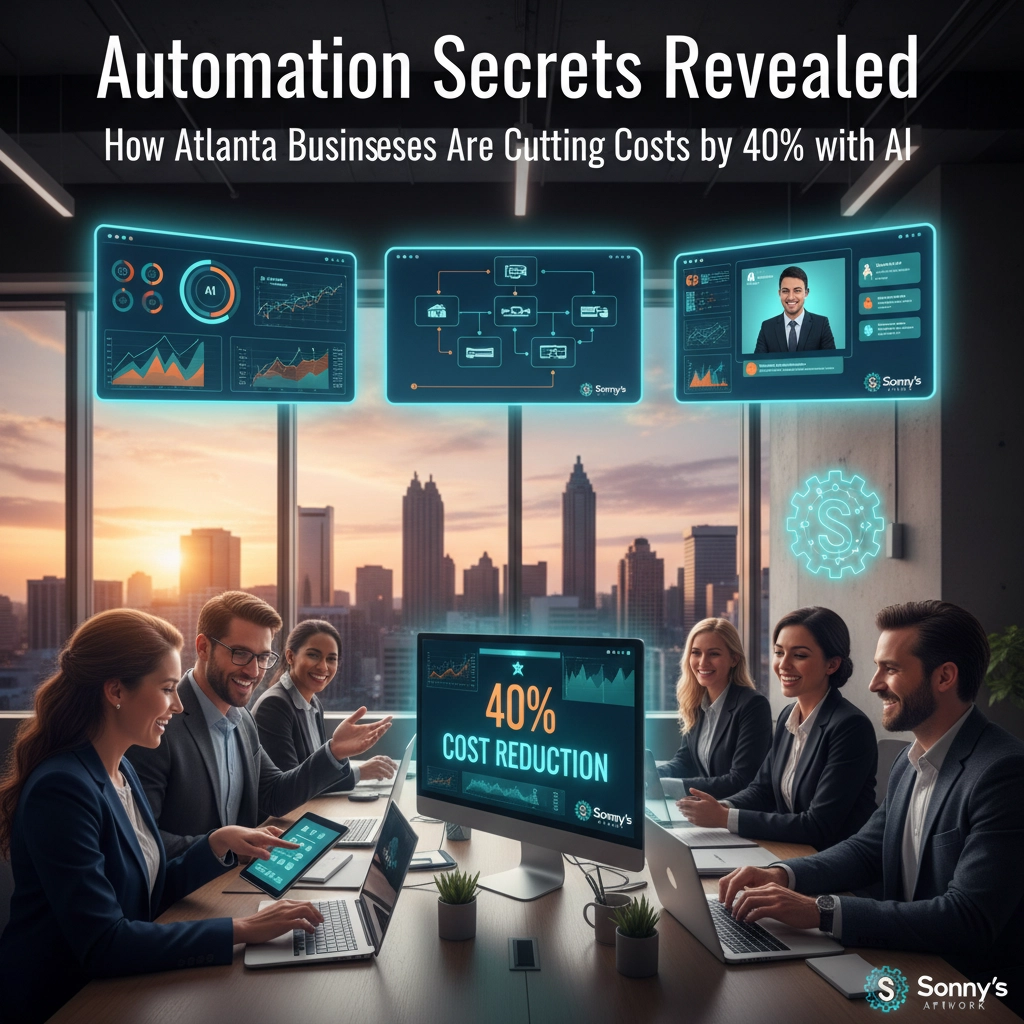
Atlanta's business landscape is experiencing a quiet revolution. While other cities debate the future of AI, Atlanta companies are already implementing automation solutions that are slashing operational costs by up to 40%. From healthcare systems to sales teams, local businesses are discovering that the right AI tools don't just improve efficiency: they fundamentally transform their bottom line.
The Numbers Don't Lie: Real Cost Savings in Action
The transformation happening across Atlanta isn't theoretical: it's measurable. Sales professionals working with local automation specialists are reporting operational cost reductions of up to 40% by implementing AI services that eliminate manual errors and free up team members to focus on high-value activities. Even more impressive? These same sales teams are saving over 18 hours per week through predictive analytics and task automation.
But Atlanta's AI success story extends far beyond sales departments. Healthcare providers like Emory Healthcare and Piedmont Healthcare are using AI tools to automate scheduling, patient communication, billing, and insurance verification. The results speak for themselves: paperwork time reduced by 40% and claims rejections cut by 30%.

Breaking Down Atlanta's AI Automation Strategy
Sales and Marketing Revolution
The most dramatic transformations are happening in sales and Marketing operations. Instead of relying on traditional demographic targeting that casts wide nets with mixed results, Atlanta sales teams are implementing intent-based audience targeting. This approach uses AI to identify prospects who are actively seeking solutions by analyzing real-time behaviors like search queries and content engagement patterns.
Local agencies are deploying Google's AI-powered audiences and Meta's Advantage+ platforms to create personalized campaigns that outperform standard targeting by 2.5 times. The key isn't just using AI tools: it's using the right combination of tools strategically.
Here's what's working for Atlanta businesses:
- Predictive lead scoring that prioritizes prospects with the highest conversion potential
- Automated email sequences that nurture leads without manual intervention
- Dynamic content personalization that adapts messaging based on user behavior
- Automated social media posting that maintains consistent brand presence
Healthcare's Administrative Transformation
Atlanta's healthcare sector has become a leader in AI-driven cost reduction, particularly in administrative tasks that traditionally consumed significant staff time and resources. The automation focuses on areas where human error is costly and time-consuming processes drain resources.
AI chatbots now provide 24/7 patient support and streamline appointment bookings, reducing wait times and optimizing patient flow within facilities. Predictive analytics help hospitals anticipate patient admission rates and manage critical resources like staffing and bed occupancy more effectively, preventing overcrowding and eliminating unnecessary expenditures.

The Technology Stack That's Making It Happen
Machine Learning and Predictive Analytics
Atlanta companies are leveraging machine learning platforms to forecast sales with up to 39% improved accuracy compared to traditional methods. Tools like Salesloft use machine learning algorithms to prioritize leads and automate routine tasks, enabling sales teams to focus on relationship building and closing deals.
The data-driven approach allows for quick adjustments based on market changes, making Atlanta businesses more agile than competitors still relying on gut instincts and manual processes.
Custom AI Automation Solutions
Rather than adopting one-size-fits-all solutions, successful Atlanta companies are working with local firms to create tailored AI automation that addresses their specific operational bottlenecks. This customization ensures that automation efforts target actual inefficiencies rather than automating processes that don't need improvement.
1040 Media Group specializes in helping Atlanta businesses identify these automation opportunities and implement solutions that deliver measurable ROI.
AI-Enhanced Documentation and Processing
Healthcare organizations are using AI-assisted documentation and Hierarchical Condition Codes (HCC) coding to improve billing accuracy and accelerate revenue cycles. This precision reduces costly errors and speeds up payment processing, directly impacting cash flow.
Manufacturing and logistics companies are implementing similar AI-enhanced documentation systems for inventory management, quality control, and supply chain optimization.

Why Atlanta Is Leading This Transformation
The combination of Atlanta's robust tech infrastructure: supported by institutions like Georgia Tech and Emory University: and the city's cost advantage positions local businesses to implement AI solutions more cost-effectively than competitors in expensive tech hubs.
Atlanta's cost of living is nearly 40% lower than major tech centers like San Francisco or New York, allowing businesses to invest more resources in technology while maintaining competitive operational costs. This economic advantage, combined with access to top-tier talent and research institutions, creates an ideal environment for AI innovation.
The Adoption Reality: What the Data Shows
Research reveals that 64% of Atlanta businesses are now using some form of AI, with the most-cited benefits being:
- Cost savings (39%)
- Time savings (38%)
- Productivity improvements (35%)
- Better decision-making capabilities (32%)
This widespread adoption reflects growing recognition that AI implementation delivers measurable returns on investment when deployed strategically.

Implementation Lessons from Atlanta's Success Stories
Start with Process Intelligence
The most successful Atlanta businesses aren't applying AI randomly. They're using process intelligence to understand their current workflows before automating them. This approach ensures they're optimizing efficient processes rather than scaling broken ones.
Focus on High-Impact, Low-Risk Areas First
Companies achieving 40% cost reductions typically start with automation in areas where:
- Manual processes are time-consuming but straightforward
- Human error is costly but preventable
- Data is readily available and well-organized
- Success can be easily measured
Invest in Training and Change Management
Atlanta businesses that achieve lasting results invest heavily in training their teams on new AI tools and managing the cultural shift that comes with automation. This investment prevents resistance and ensures that AI tools are used to their full potential.
Future-Proofing Your Business with AI Automation
The companies achieving dramatic cost savings aren't just implementing current AI solutions: they're building automation capabilities that can evolve with advancing technology. This forward-thinking approach positions them to benefit from future AI developments without starting from scratch.
Looking ahead, industry projections suggest that AI could automate up to 70% of routine administrative tasks across various sectors, potentially generating annual savings exceeding $150 billion by 2030. Atlanta businesses implementing automation today are positioning themselves to capture a significant portion of these savings.
Taking Action: Your Next Steps
The evidence is clear: AI automation isn't a future possibility: it's a current competitive advantage that Atlanta businesses are using today to cut costs and improve operations. The question isn't whether to implement AI automation, but how quickly you can get started.
Ready to explore how AI automation can transform your business operations? Contact 1040 Media Group to discover automation opportunities specific to your industry and operational challenges. Our team specializes in helping Atlanta businesses implement AI solutions that deliver measurable cost savings and competitive advantages.
Don't let your competitors gain the 40% cost advantage while you're still debating the benefits of automation. The Atlanta businesses leading this transformation started with a single automation project: and so can you.
The Ultimate Guide to Building High-Converting Sales Funnels in 2025

Sales funnels have evolved dramatically in 2025, and the businesses that understand these changes are crushing their revenue goals while others struggle with outdated strategies. The difference between a funnel that converts at 2% and one that converts at 15% isn't luck: it's understanding how modern buyers make decisions and building your funnel accordingly.
Why Traditional Funnels Are Failing in 2025
The old "spray and pray" approach to sales funnels is dead. Today's buyers are more informed, more skeptical, and have shorter attention spans than ever before. They're researching your competitors while reading your sales page, fact-checking your claims in real-time, and making purchase decisions based on peer reviews and social proof rather than your Marketing copy alone.
Traditional funnels fail because they treat all prospects the same way. They assume everyone enters at the same awareness level and needs the same information in the same order. This one-size-fits-all approach is why most businesses see conversion rates stuck in the single digits.
The Modern Buyer's Journey
Today's buyers don't follow linear paths. They might discover your brand through a TikTok video, research you on LinkedIn, read reviews on Google, check your competitors' pricing, and then return to your Website three weeks later ready to buy. Your funnel needs to accommodate this non-linear journey.
The most successful companies in 2025 are building adaptive funnels that respond to where prospects are in their journey and what they need to move forward. These funnels use behavioral data, AI personalization, and dynamic content to deliver the right message at the right time.
The Anatomy of a High-Converting 2025 Funnel
Stage 1: Awareness with Intent Detection
Modern awareness-stage content doesn't just attract eyeballs: it identifies buyer intent. Instead of generic blog posts or social media content, high-converting funnels use:
- Interactive assessments that provide value while gathering qualification data
- Problem-solving tools that demonstrate your expertise while identifying pain points
- Educational content that answers specific questions your ideal customers are asking
The key is creating content that serves dual purposes: providing immediate value while collecting behavioral data that informs personalization throughout the funnel.
Stage 2: Interest with Social Proof Integration
The interest stage is where most funnels lose prospects because they focus on features instead of outcomes. High-converting funnels in 2025 lead with social proof and outcome-focused messaging:
- Video testimonials from customers in similar situations
- Case studies with specific metrics and timelines
- Live social proof showing recent purchases or sign-ups
- Community-generated content that builds trust through peer validation

Stage 3: Consideration with Personalized Experiences
This is where AI and automation create the biggest impact. Instead of sending everyone the same email sequence or showing the same product demos, successful funnels adapt based on:
- Browsing behavior and page engagement data
- Survey responses and assessment results
- Demographics and firmographic information
- Traffic source and referral context
For example, someone who found you through a competitor comparison search needs different messaging than someone who discovered you through a thought leadership article.
Stage 4: Decision with Friction Elimination
The decision stage is where you win or lose the sale. High-converting funnels in 2025 eliminate every possible point of friction:
- One-click purchasing with saved payment information
- Flexible payment options including buy-now-pay-later
- Risk reversal with money-back guarantees and free trials
- Urgency creation through limited-time offers or scarcity
But here's the crucial part: the urgency and scarcity must be authentic. Modern buyers can spot fake countdown timers and artificial scarcity, and these tactics now backfire more often than they work.
Leveraging Technology for Funnel Optimization
AI-Powered Personalization
The biggest game-changer for 2025 funnels is AI that can personalize experiences in real-time. This goes beyond inserting someone's name in an email: it's about dynamically adjusting your entire funnel based on behavioral data.
Advanced personalization includes:
- Dynamic landing pages that change based on traffic source
- Adaptive email sequences that adjust timing and content based on engagement
- Personalized product recommendations using collaborative filtering
- Behavioral triggers that launch specific sequences based on actions taken
Conversion Rate Optimization Through Testing
High-converting funnels are never "finished": they're constantly optimized through systematic testing. But 2025 testing goes beyond simple A/B tests of headlines and button colors:
- Multivariate testing of entire funnel sections
- Behavioral cohort analysis to understand different user segments
- Predictive testing using AI to model potential improvements
- Cross-device optimization for seamless mobile-to-desktop experiences
Integration and Attribution
Modern funnels don't exist in isolation: they're integrated across multiple platforms and touchpoints. Successful businesses track prospects across:
- Social media platforms where initial awareness happens
- Email Marketing systems for nurturing and follow-up
- CRM platforms for sales team handoffs
- Customer success platforms for post-purchase optimization
This integration enables accurate attribution modeling so you know which touchpoints contribute to conversions and can optimize budget allocation accordingly.
Platform-Specific Optimization Strategies
Social Media Funnels
Social media funnels in 2025 focus on micro-commitments that gradually increase engagement:
- Content consumption (watching videos, reading posts)
- Engagement actions (likes, comments, shares)
- Profile visits and follower conversions
- Link clicks to owned properties
- Email subscriptions or app downloads
- Purchase decisions or consultation bookings
The key is making each step feel natural and valuable rather than pushy or sales-focused.
Email Marketing Funnels
Email remains one of the highest-ROI channels, but successful email funnels in 2025 focus on value delivery over promotion:
- Educational sequences that solve problems before selling solutions
- Behind-the-scenes content that builds personal connections
- User-generated content that showcases community and social proof
- Interactive elements like polls, quizzes, and surveys that increase engagement
Paid Advertising Funnels
Paid advertising funnels are becoming more sophisticated with better targeting and measurement capabilities:
- Lookalike audiences based on high-value customer characteristics
- Retargeting sequences that adapt based on previous interactions
- Cross-platform attribution that tracks users across devices and platforms
- Value-based bidding that optimizes for customer lifetime value rather than just conversions
Measuring and Optimizing Funnel Performance
Key Performance Indicators (KPIs)
The metrics that matter for funnel optimization go beyond simple conversion rates:
- Cost per acquisition (CPA) across all touchpoints
- Customer lifetime value (CLV) to understand long-term profitability
- Time to conversion to optimize nurturing sequences
- Engagement depth to identify interested prospects
- Attribution accuracy to understand multi-touch journeys
Advanced Analytics and Reporting
Modern funnel optimization requires sophisticated analytics that can track complex customer journeys:
- Multi-touch attribution modeling that assigns value to each touchpoint
- Cohort analysis to understand how different customer segments behave
- Predictive analytics to identify prospects most likely to convert
- Real-time optimization that adjusts campaigns based on performance data
Companies achieving the highest funnel conversion rates use data visualization tools that make complex customer journey data actionable for Marketing and sales teams.
Implementation Roadmap for Your High-Converting Funnel
Phase 1: Foundation and Mapping (Weeks 1-2)
- Audit your current funnel performance and identify bottlenecks
- Map your ideal customer journey across all touchpoints
- Set up tracking and analytics infrastructure
- Define success metrics and benchmarks
Phase 2: Content and Experience Creation (Weeks 3-6)
- Develop personalized content for each funnel stage
- Create interactive elements and social proof components
- Build email sequences and automation workflows
- Design landing pages optimized for conversion
Phase 3: Technology Integration and Testing (Weeks 7-8)
- Implement AI personalization and behavioral triggers
- Set up cross-platform integration and attribution tracking
- Launch A/B tests for key funnel components
- Train team members on new tools and processes
Phase 4: Optimization and Scaling (Ongoing)
- Analyze performance data and identify improvement opportunities
- Expand successful elements to additional traffic sources
- Develop new funnel variations for different customer segments
- Scale advertising spend on highest-performing campaigns
Taking Your Funnel to the Next Level
Building a high-converting sales funnel in 2025 requires more than following a template: it requires understanding your specific audience, leveraging modern technology, and continuously optimizing based on data. The businesses that master this approach don't just improve their conversion rates: they transform their entire revenue generation process.
Ready to build a sales funnel that consistently converts prospects into customers? Explore our funnel optimization services to discover how we help Atlanta businesses create automated systems that generate predictable revenue growth.
The difference between struggling with inconsistent sales and building a predictable revenue engine comes down to implementing the right funnel strategy for your business. Don't let another month pass with underperforming conversion rates( start building your high-converting funnel today.)